No products in the cart.
Return To Shop
Out of stock
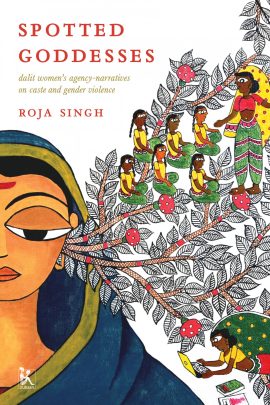
Spotted Goddesses: Dalit Women’s Agency-Narratives on Caste and Gender Violence
₹ 795During the current COVID-19 surge we are shipping orders from Delhi once per week. Please allow 8-10 business days for delivery.
Spotted Goddesses is an ethnography of caste, gender and Dalit women’s leadership. Situated within the ambit of transnational feminisms, this book is rooted in interactions and lived experiences of Dalit women in Tamil Nadu. Singh’s intersectional perspective as a Dalit woman provides a consummate analysis of the power structures that shape the foundation of caste dominance in South India today. She describes strategies of social change in Dalit women’s activism as embedded in the urge to upend and subvert imposed identities of ‘difference’ in a mode of resistance which fearlessly thwarts social compartments and punishment traditions.Built around a powerful core which is primarily shaped by Dalit women’s songs, and oral and written testimonial narratives, including Singh’s personal story, this interdisciplinary work is a searing vindication of Dalit women’s right to rise and rage against the shackles of Brahminical patriarchy.“…powerfully describes how Dalit women free themselves from the degrading stereotypes of impurity, inferiority and inequality…” — Bama, author of Karukku and Sangati
“…personal and profound, Singh smashes disciplinary boundaries while illuminating the lived experiences of women who have long been marginalized by traditional feminist discourse…” — Smita Narula, author of Broken People: Caste Violence Against India’s ‘Untouchables’
“A powerful, poignant treatment of the Dalit plight and predicament with a courageous vision of resistance.” — Dr. Cornel West, scholar, writer, activist and philosopher
ROJA SINGH teaches interdisciplinary studies including Anthropology, Sociology and Women and Gender Studies at St. John Fisher College, Rochester, New York. Her ongoing research involves the oral narratives and leadership strategies of women from indigenous communities. She is president of the Dalit Solidarity Forum USA.
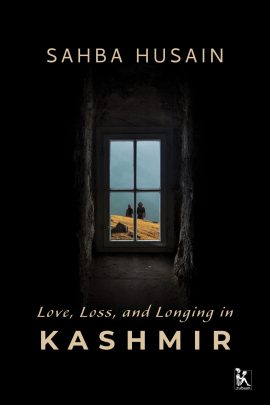
Love, Loss, and Longing in Kashmir
Price range: ₹ 298 through ₹ 595
In this personal and passionate account, activist and researcher Sahba Husain documents her deeply engaged and empathetic involvement with the politicised terrain of Kashmir. As she meets people that she speaks with and, more importantly, listens to, she begins to question her own ‘Indian’ identity. Recognizing the anger, despair and helplessness of a people caught in conflict and violence, Husain forms deep friendships during her time working in the state.It is these relationships that form the backdrop of this book, in which Husain focuses on certain key areas: the health of a people, militancy and its changing meanings for local people and the state, impunity and the search for justice, migration and the longing for homes left behind, and women’s activism in the faultlines of nation-state and community. A book of surprising beauty in its engagement with human relationships, of love for a land and a people and of hope for a future free of violence, Love, Loss, and Longing in Kashmir is a compelling and necessary read.PUBLISHER'S NOTE: As this book goes to press, there is news of the abrogation, by the Indian government, of Article 370 of the Indian Constitution that grants special status to the state of Jammu and Kashmir. Major changes that affect the lives of people in Kashmir are being put in place. Currently, there is a heavy presence of the armed forces, curfew is in place, telephone and internet lines have been suspended, people are in fear and there is huge bewilderment, confusion, anger. No one knows what the future will hold. This book, the result of long years of engagement with Kashmir, ends on a note of hope. It is our hope and belief too that whatever the future holds, it is the people of Kashmir who will shape it for their state and their world.
SAHBA HUSAIN is an independent researcher and women’s rights activist. For the last two decades, she has travelled extensively in Jammu and Kashmir, documenting the social consequences of armed conflict, mass violence and militarization on individuals, families and communities, with a special focus on women. Her earlier research focused on problems of working women in the organized and unorganized sectors in several states of India and on the impact of development policies on women’s social, political and economic status.
Select format
This product has multiple variants. The options may be chosen on the product page SAHBA HUSAIN is an independent researcher and women’s rights activist. For the last two decades, she has travelled extensively in Jammu and Kashmir, documenting the social consequences of armed conflict, mass violence and militarization on individuals, families and communities, with a special focus on women. Her earlier research focused on problems of working women in the organized and unorganized sectors in several states of India and on the impact of development policies on women’s social, political and economic status.

Books, Books from the North East, Books from the North East, e-Books, Fiction, Fiction, New Releases, New Releases, Non-Fiction, Non-Fiction
The Many That I Am: Writings from Nagaland
Price range: ₹ 350 through ₹ 495
A grandmother’s tattoos, the advent of Christianity, stories woven into fabrics, a tradition of orality, the imposition of a ‘new’ language, a history of war and conflict: all this and much more informs the writers and artists in this book. Filmmaker and writer Anungla Zoe Longkumer brings together here, for the first time, a remarkable set of stories, poems, first-person narratives and visuals that reflect the many facets of women’s writing in Nagaland.Written in English, a language the Nagas — who had no tradition of written literature — made their own after the Church came to Nagaland, each piece speaks of women’s many journeys to reclaim their pasts and understand their complex present.
Contributors: Abokali Jimomi, Ahikali Swu, Aniho Chishi, Anungla Zoe Longkumer, Avinuo Kire, Beni Sumer Yanthan, Dzuvinguno Dorothy Chasie, Easterine Kire, Em Em El, Emisenla Jamir, Eyingbeni Humtsoe-Nienu, Hekali Zhimomi, Iris Yingzen, Jungmayangla Longkumer, Kutoli N, Licca Kiho, Limatola Longkumer, Manenjungla Aier, Marianne Murry, Moaso Aier, Narola Changkija, Neikehienuo Mepfhüo, Nini Lungalang, Phejin Konyak, rōzumarī saṃsāra, Sirawon Tulisen Khathing, Metongla Aier, Talilula, Temsula Ao, Thejakhrienuo Yhome, Theyie Keditsu, Vishü Rita Krocha.
ANUNGLA ZOE LONGKUMER can best be described as a free individual discovering her way through creative pursuits in music, writing, filmmaking, and folk traditions. Having travelled and lived outside Nagaland during most of her life, she is currently based in Dimapur, Nagaland, where she freelances doing some content editing, music and filmmaking. She is the author of Folklore of Eastern Nagaland (2017), that comprises translations of folktales, folk songs and real-life accounts, collected from the six tribes who inhabit the more remote districts of Eastern Nagaland.
Select format
This product has multiple variants. The options may be chosen on the product page Contributors: Abokali Jimomi, Ahikali Swu, Aniho Chishi, Anungla Zoe Longkumer, Avinuo Kire, Beni Sumer Yanthan, Dzuvinguno Dorothy Chasie, Easterine Kire, Em Em El, Emisenla Jamir, Eyingbeni Humtsoe-Nienu, Hekali Zhimomi, Iris Yingzen, Jungmayangla Longkumer, Kutoli N, Licca Kiho, Limatola Longkumer, Manenjungla Aier, Marianne Murry, Moaso Aier, Narola Changkija, Neikehienuo Mepfhüo, Nini Lungalang, Phejin Konyak, rōzumarī saṃsāra, Sirawon Tulisen Khathing, Metongla Aier, Talilula, Temsula Ao, Thejakhrienuo Yhome, Theyie Keditsu, Vishü Rita Krocha.
ANUNGLA ZOE LONGKUMER can best be described as a free individual discovering her way through creative pursuits in music, writing, filmmaking, and folk traditions. Having travelled and lived outside Nagaland during most of her life, she is currently based in Dimapur, Nagaland, where she freelances doing some content editing, music and filmmaking. She is the author of Folklore of Eastern Nagaland (2017), that comprises translations of folktales, folk songs and real-life accounts, collected from the six tribes who inhabit the more remote districts of Eastern Nagaland.
In stock
Unruly Visions: The Aesthetic Practices of Queer Diaspora
Price range: ₹ 348 through ₹ 695During the current COVID-19 surge we are shipping orders from Delhi once per week. Please allow 8-10 business days for delivery.
In Unruly Visions, Gayatri Gopinath brings queer studies to bear on investigations of diaspora and visuality, tracing the interrelation of affect, archive, region and aesthetics through an examination of a wide range of contemporary queer visual culture. Spanning film, fine art, poetry and photography, these cultural forms—which Gopinath conceptualizes as aesthetic practices of queer diaspora—reveal the intimacies of seemingly disparate histories of (post)colonial dwelling and displacement and are a product of diasporic trajectories.Countering standard formulations of diaspora that inevitably foreground the nation-state, as well as familiar formulations of queerness that ignore regional gender and sexual formations, Gopinath stages unexpected encounters between works by South Asian, Middle Eastern, African, Australian and Latinx artists such as Sheba Chhachhi, Allan deSouza, Tracey Moffat and Akram Zaatari. Unruly Visions shows how their art functions as regional queer archives that express alternative understandings of time, space, and relationality.The queer optics produced by these visual practices create South-to-South, region-to-region and diaspora-to-region cartographies that profoundly challenge disciplinary and area studies rubrics. Gopinath thereby provides new critical perspectives on settler colonialism, empire, military occupation, racialization and diasporic dislocation as they indelibly mark both bodies and landscapes.“A tremendous advance over the current scholarship analyzing visuality, affect, and South-to-South queer diasporic artistic expression, Unruly Visions charts new cartographies of diasporic connections that provide a fresh orientation to our understanding of settler colonialism, empire, and racialization. Gayatri Gopinath’s book is a singular achievement that will have a profound impact within queer studies, indigenous and diaspora studies, visual studies, and aesthetics.” —Nayan Shah, author of Stranger Intimacy: Contesting Race, Sexuality, and the Law in the North American West
“A wonderfully detailed examination of queer diasporic films and visual art projects, this book explores how critical regionalism can interrupt conventional conceptions of local/global and metropolis/diaspora distinctions. Gayatri Gopinath's concept of a 'queer cartographic imaginary' resists neat categories and generalizations, offering an eclectic range of case studies—queer diaspora from Kerala and the Middle East, Latinx and U.S. cultures of immigration, and indigeneity.” —Ann Cvetkovich, author of Depression: A Public Feeling
GAYATRI GOPINATH is Associate Professor in the Department of Social and Cultural Analysis at New York University. She works at the intersections of transnational feminist and queer studies, postcolonial studies and diaspora studies.
In stock

Fierce Femmes and Notorious Liars: A Dangerous Trans Girl’s Confabulous Memoir
₹ 350
LAMBDA LITERARY AWARD FINALIST 2017A haunted young girl (who happens to be a Kung-fu expert and pathological liar) runs away from an oppressive city, where the sky is always grey; in search of love and sisterhood, she finds herself in a magical place known only as the Street of Miracles.There, she is quickly adopted into the vigilante gang of glamorous warrior femmes called the Lipstick Lacerators, whose mission is to scour the Street of violent men and avenge murdered trans women everywhere. But when disaster strikes, can our intrepid heroine find the truth within herself in order to protect her new family and heal her broken heart?
KAI CHENG THOM is a writer, performer, lasagna lover, and wicked witch based in Toronto, unceded Indigenous territory. She is the author of several award-winning works including the poetry collection a place called No Homeland, the children’s book From the Stars in the Sky to the Fish in the Sea, and the essay collection I HOPE WE CHOOSE LOVE: A Trans Girl’s Notes from the End of the World. Fierce Femmes and Notorious Liars: A Dangerous Trans Girl’s Confabulous Memoir is her first novel.
Add to cart
KAI CHENG THOM is a writer, performer, lasagna lover, and wicked witch based in Toronto, unceded Indigenous territory. She is the author of several award-winning works including the poetry collection a place called No Homeland, the children’s book From the Stars in the Sky to the Fish in the Sea, and the essay collection I HOPE WE CHOOSE LOVE: A Trans Girl’s Notes from the End of the World. Fierce Femmes and Notorious Liars: A Dangerous Trans Girl’s Confabulous Memoir is her first novel.
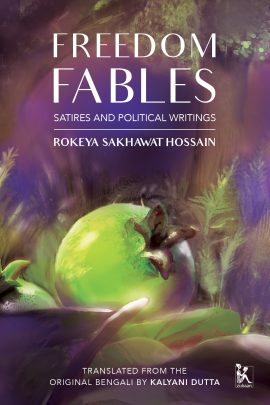
Freedom Fables: Satires and Political Writings
Price range: ₹ 198 through ₹ 395
From Rokeya Sakhawat Hossain (1880-1932), the writer of the feminist utopian fantasy ‘Sultana’s Dream’, come these tales of gumptious wit, describing the twists and turns of India’s two-hundred-year relationship with the imperial British.Freedom Fables begins with the two eponymous fables, both compact in form but temporally vast. The first story ‘Muktiphal’ (translated in this volume as ‘The Freedom Tree’) traces the rise of and divisions within India’s Congress party. ‘Gyanphal’ or ‘The Tree of Knowledge’, the second fable, begins in the Garden of Eden and moves swiftly to an idealised Kanakadwipa where a trading company beguiles the prosperous country and proceeds to ruin it. Throughout both, the fantastic floats easily over mere facts. Adam and Eve, the Almighty, djinns, paris, demons, and Mayavi magicians: these classic characters play decisive, intriguing roles.These major political satires are accompanied in this edition by six essays and two poems, which the intrepid Hossain wrote over a period of seventeen years. Interwoven through her writings are ideals that endure even today: education and emancipation for women, dignity for those living in the subcontinent, and freedom from colonial rule and influence.
ROKEYA SAKHAWAT HOSSAIN was a feminist activist and writer, as well as a visionary campaigner for women’s education. Born in 1880 in Rangpur (in what is contemporary Bangladesh), Hossain—also known as Begum Rokeya—wrote prolifically on issues of women’s liberation and against British colonial rule over India. Her ‘Sultana’s Dream’, written in 1905, is arguably the first work of feminist science fiction from Asia. Hossain founded the Muslim Women’s Association in 1916 to fight for women’s education and employment. She remained fiercely engaged in feminist debates and conferences until her death in 1932.KALYANI DUTTA is an award-winning translator. Her translations from Bengali to English form a part of The Essential Tagore, published by Harvard University Press in 2011. She is also the co-author of Women, Education, and Politics: The Women’s Movement and Delhi’s Indraprastha College which brings together her twin interests, women’s studies and education.
Select format
This product has multiple variants. The options may be chosen on the product page “It was perhaps in the rancorous tumult of the breaking and making of nations that Rokeya Sakhawat Hossain’s word and vision was lost.” — Rafia Zakaria, Dawn
“You can feel Hossain’s anger... and her scathing criticism of a system that allows what she saw as lazy, violent men to dominate while their gentler, wiser female counterparts are marginalized.” — Tahmima Anam, NPR
"“Hossain slyly pointed out back in 1905 what is often discussed now, particularly in the subcontinent—why should women be taught to stay safe, when men are not taught to not threaten or abuse or rape or be a danger to women?” — Mahvesh Murad, Tor.com
ROKEYA SAKHAWAT HOSSAIN was a feminist activist and writer, as well as a visionary campaigner for women’s education. Born in 1880 in Rangpur (in what is contemporary Bangladesh), Hossain—also known as Begum Rokeya—wrote prolifically on issues of women’s liberation and against British colonial rule over India. Her ‘Sultana’s Dream’, written in 1905, is arguably the first work of feminist science fiction from Asia. Hossain founded the Muslim Women’s Association in 1916 to fight for women’s education and employment. She remained fiercely engaged in feminist debates and conferences until her death in 1932.KALYANI DUTTA is an award-winning translator. Her translations from Bengali to English form a part of The Essential Tagore, published by Harvard University Press in 2011. She is also the co-author of Women, Education, and Politics: The Women’s Movement and Delhi’s Indraprastha College which brings together her twin interests, women’s studies and education.
Gender and Governance: Perspectives from South Asia
Price range: ₹ 398 through ₹ 795
This book examines the structures of governance as they impact women in five conflict zones in South Asia: Swat in Pakistan, the Chittagong Hill Tracts in Bangladesh, the Northern Province in Sri Lanka, and Kashmir and Manipur in India.Despite their different historical and political contexts, the five studies included here throw up some common patterns. War and conflict have weakened and eroded existing formal structures and institutions of governance. New formations, whether made up of militant groups, or more ‘secular’ state institutions like armies, do not see women as rights-bearing actors. Further, the authors argue, the impact of war, conflict, settlerism and militancy can make state structures more distant and sometimes incomprehensible to citizens, leaving women’s specific gender concerns unaddressed.Taken together, the essays show that women’s relationship with governance institutions is complex, and combines dependence on such institutions with the challenge of dealing with new forms of patriarchy that take root as structures transform and change. The gendering of governance policy and practice therefore, is of crucial importance.CONTRIBUTORS: Amena Mohsin | Delwar Hossain | Nazish Brohi Saba Gul Khattak | Malathi De Alwis | Udhayani Navaratnam | Nima Lamu Yolmo | Shaheena Parveen | Ayesha Parvez | Seema Kazi
Select format
This product has multiple variants. The options may be chosen on the product page 
Disputed Legacies: The Pakistan Papers
Price range: ₹ 425 through ₹ 850
The Sexual Violence and Impunity in South Asia research project (coordinated by Zubaan and supported by the International Development Research Centre) brings together, for the first time in the region, a vast body of knowledge on this important – yet silenced – subject. Six country volumes (one each on Bangladesh, Nepal, Pakistan, Sri Lanka, and two on India) comprising over fifty research papers and two book-length studies detail the histories of sexual violence and look at the systemic, institutional, societal, individual and community structures that work together to perpetuate impunity for perpetrators.Disputed Legacies focuses on Pakistan, examining law, pedagogy, medical practice and the situations that arise when ‘secular’ law comes into conflict with traditional practice and belief. The contributors to this volume trace the often-troubled interaction between the state and its women citizens and examine the structures and social systems that enable impunity for perpetrators of sexual violence to gain strength.CONTRIBUTORS: Sahar Zareen Bandial | Nazish Brohi | Iftikhar Firdous | Huma Qurban Fouladi | Neelam Hussain | Hooria Hayat Khan | Zainab Zeeshan Malik | Noreen Naseer | Zahaid Rehman | Fahmida Riaz | Rubina Saigol | Zahra Shah | Sarah Zaman | Afiya Shehrbano Zia | Maliha Zia
Select format
This product has multiple variants. The options may be chosen on the product page 
Waiting: A Collection of Stories
Price range: ₹ 213 through ₹ 425
In this new collection by well- known author Nighat Gandhi, the private worlds of women open themselves up to the reader. Inside their homes are women trapped in a state of continuous limbo, waiting for change; young girls struggling for the ‘purity’ that religion demands of them; new mothers who wonder at the absence of desire. Outside, the seasons change, trees shed their leaves, the sky becomes overcast, sounds float in to them and they wonder about the meaning of life. Each of the stories bring questions for the reader, their nuanced telling and their unsparing truthfulness leave readers with a sense of discomfort as they confront their own demons. Love, longing, loss, aging, survival, hope and self-invention—in other words, life— are what these stories are about.
NIGHAT GANDHI is a mental health counsellor, a mother, a South Asian, queer-feminist, Vipassana meditator, and a student of Taṣawwuf (Sufism). She wrote many of these stories armed with cups of Leo coffee, riddled with self-doubt, and bothered by back pain as a result of spending hours hunched over her laptop, in the comforting company of her two dearest companions, Dodi and Heidu, who snoozed on the floor and kept sleepful watch over her. Waiting is her fourth book.
Select format
This product has multiple variants. The options may be chosen on the product page “A clear-eyed view of life’s innate contradictions” —Mita Ghose, The Hindu
“Allahabad may just have found her Chekov” — Irwin Allan Sealy
“Touches of poetry” — Anjana Basu, Outlook
NIGHAT GANDHI is a mental health counsellor, a mother, a South Asian, queer-feminist, Vipassana meditator, and a student of Taṣawwuf (Sufism). She wrote many of these stories armed with cups of Leo coffee, riddled with self-doubt, and bothered by back pain as a result of spending hours hunched over her laptop, in the comforting company of her two dearest companions, Dodi and Heidu, who snoozed on the floor and kept sleepful watch over her. Waiting is her fourth book.
In stock

I Am
Price range: ₹ 113 through ₹ 225During the current COVID-19 surge we are shipping orders from Delhi once per week. Please allow 8-10 business days for delivery.
 Everyone thinks they know who I am.Do you think that too?Or are you ready to listen to what happened, hidden inside these pages?
_______
This terrific book gently introduces ideas of identity and selfhood through textured typography and rich, striking colours.