No products in the cart.
Return To Shop

Swimming in Our Oceans: A Memoir by Pragya Bhagat
Price range: ₹ 325 through ₹ 495
Swimming In Our Oceans traverses the uncertainties and contradictions that shape who we are. The memoir explores performance, invisibility, and mental health, following Pragya's move to a village in Uttarakhand. Alternating between the author’s past and present, Swimming in Our Oceans questions what it means to belong – to a place, to a person, to oneself.
PRAGYA BHAGAT is a poet and essayist. Her work explores the intersections between belonging, body image, and mental health. Her work has been featured in the BBC, The Alipore Post, The Huffington Post, Kommune, and The Wire, amongst others. She currently lives in Goa where she hosts a fortnightly meet-up called The Poetry Circle. Continue Reading Swimming in Our Oceans: A Memoir by Pragya Bhagat
Select format
This product has multiple variants. The options may be chosen on the product page PRAGYA BHAGAT is a poet and essayist. Her work explores the intersections between belonging, body image, and mental health. Her work has been featured in the BBC, The Alipore Post, The Huffington Post, Kommune, and The Wire, amongst others. She currently lives in Goa where she hosts a fortnightly meet-up called The Poetry Circle. Continue Reading Swimming in Our Oceans: A Memoir by Pragya Bhagat
In stock

Walking Out, Speaking Up: Feminist Street Theatre in India
Price range: ₹ 560 through ₹ 795
An energetic era of feminist street theatre in India: 1979 onwards. Stunning, audacious plays vividly portray abuse, murder and everyday sexism, raise profound questions, disrupting the normative. Public performance embodies resistance, shattering the mould of docile, invisible women. Rhythms of tambourines, drums, songs fill the air, stories are enacted, insights communicated, challenging entrenched patriarchies, evoking audience response, sparking change.A remarkable repertoire of plays unfolded across geographical and social contexts: Om Swaha, Ehsaas, Mulgi Zali Ho, Intezaar, Teri Meri Kahani, Hum Awaz Uthayeinge and hundreds more. Weaving social critique with intimate felt experience, they exposed dowry killings, sati, bigotry, sexual violence, overwork, discrimination and exploitation within families, workplaces, society and state—and showed rebellion brewing. This was a theatre of rage, pain, protest, in sync with the autonomous women’s movement of the time.Perceptive, outspoken women emerged out of a morass of ascribed roles to carve their own identities, remake the world. Protagonists broke many silences, told precious stories, offered alternative imaginaries. Fiction merged with documentary, searing content with rich aesthetics. Pithy dialogues articulated complex ideas in familiar idioms, heralding increasingly nuanced discourse around gender, citizenship and dissent, influencing media, academia, law and policy.Incorporating oral histories, auto-ethnography, scripts, visuals, archival material, meticulous research and multi-layered analysis, Deepti Priya Mehrotra’s carefully crafted study is an invaluable resource for understanding feminist street theatre, oppositional politics and counter-cultures in modern India.______________________________________________________________________________________Deepti Priya Mehrotra is a political scientist with trans-disciplinary interests. She has engaged with street theatre and the women’s movement since the late 1970s. Writing in English and Hindi, her books include Gulab Bai: the Queen of Nautanki Theatre, Home Truths: Stories of Single Mothers, Burning Bright: Irom Sharmila and the Struggle for Peace in Manipur, Her Stories: Thinkers, Workers, Rebels, Queens, Bharatiya Mahila Andolan: Kal Aaj aur Kal and Jaggi Devi: Svatantrata ki Raah Par. Deepti has taught political science, sociology, gender studies and media studies, variously at Delhi University, TISS-Mumbai, Dayalbagh Educational Institute, Agra, Ambedkar University, Delhi and the Institute of Mass Communication, Delhi. Currently, she is working on a photo archive of the autonomous women’s movement, teaching a course in educational philosophy, and collaborating with social organisations in activist, research and advisory roles. In her dissentful heart, she continues to dream of acting and singing, loudly in order to shatter the sorry scheme of things and remould it nearer to the heart’s desire. Continue Reading Walking Out, Speaking Up: Feminist Street Theatre in India
Select format
This product has multiple variants. The options may be chosen on the product page 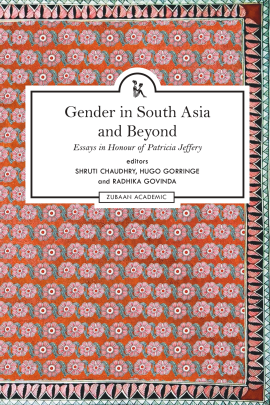
Gender in South Asia And Beyond: Essays in Honour of Patricia Jeffery
Price range: ₹ 625 through ₹ 895For over 40 years, Professor Patricia Jeffery, Professor Emerita in Sociology, University of Edinburgh, carried out pioneering research, individually and in partnership with her colleagues. The range of subjects she covered includes gender and development, especially childbearing, women’s reproductive rights, social demography in South Asia, Indian society, gender and communal politics, education and the reproduction of inequality; race and ethnicity. Her books, including Frogs in a Well: Indian Women in Purdah (1979) and Appropriating Gender: Women’s Activism, Politicized Religion and the State in South Asia (edited with Amrita Basu, 1998) inspired peers and future scholars alike. In this volume, we bring together a range of new research that is inspired by and intersects with Professor Jeffery’s work. The chapters offer new data, refreshing insights and original analysis on subjects of contemporary importance in the fields of gender, health, marginalization and development.
______________________________________________________________________________________
SHRUTI CHAUDHRY is a Chancellor’s Fellow in Sociology at the University of Edinburgh. Her doctoral research was completed at Edinburgh Sociology and was supervised by Patricia Jeffery. Her research focuses on migration, family and intimate relationships, ageing and the life course, social change, gender and intersecting inequalities explored in the context of India and the South Asian diasporas in Scotland. She is the author of Moving for Marriage: Inequalities, Intimacy and Women’s Lives in Rural North India (2021), a comparative ethnographic study of women who migrate for marriage, regionally and cross-regionally, to become brides in western Uttar Pradesh.
HUGO GORRINGE is a senior lecturer in Sociology and former co-director of the Centre for South Asian Studies at the University of Edinburgh. His first academic post was as a replacement lecturer to Patricia Jeffery. His research interests focus on Dalit movements and politics in the south Indian state of Tamil Nadu. He is the author of Untouchable Citizens (2005) and Panthers in Parliament (2017) which address the rise of the Viduthalai Chiruthaigal Katchi (VCK) and their entry into politics. He has co-edited a number of volumes including From the Margins to the Mainstream (2016, with Suryakant Waghmore and Roger Jeffery), Civility in Crisis (2020, with Suryakant Waghmore) and Caste in Everyday Life (2023, with Dhaneswar Bhoi). He has also written numerous articles on caste, violence and politics.
RADHIKA GOVINDA is a senior lecturer in Sociology at the School of Social and Political Science, University of Edinburgh and the Director of GENDER.ED – the university’s interdisciplinary hub for gender and sexualities studies. She convenes Gender and Development – a postgraduate course that Patricia Jeffery designed and convened for many years. Her research focuses on the gender politics of development, intersecting inequalities and feminist knowledge production. She has co-edited Doing Feminisms in the Academy in India and the UK (Zubaan 2021, with Fiona Mackay, Krishna Menon and Rukmini Sen). She has also published a number of articles on gender, caste, masculinities, feminist activism and development in India.
Continue Reading Gender in South Asia And Beyond: Essays in Honour of Patricia JefferyIn stock

Off The Beaten Track
₹ 499
Saeeda Bano was the first woman in India to work as a radio newsreader, and she is still known as the doyenne of Urdu broadcasting. Over her unconventional and courageous life, Bano walked out of a suffocating marriage, witnessed the violence of Partition, lost her son for a night in a refugee camp, ate toast with Nehru, and fell in love with a married man who would, in the course of their twenty-five year-relationship, become the Mayor of Delhi. Though she was born into privilege in Bhopal—the only Indian state to be ruled by women for four successive generations—her determination, independence, and frankness provide a unique and crucial disruption in India’s understanding of the past. Translated from Urdu by Bano’s granddaughter, Off the Beaten Track is a frank and brave memoir about the remarkable life of a single woman in mid-twentieth-century India.
SAEEDA BANO is the first woman in India to work as a radio newsreader.SHAHANA RAZA is Saeeda Bano's grand-daughter. She has a Master's in Film and Viedo Production and has worked in television, radio and other print media. A liberal feminist, Shahana is an independent writer and video producer, a wannabe vegan and a dilettante environmentalist. She currently lives in Dubai with her husband and two children. Continue Reading Off The Beaten Track
Add to cart
“Generously studded with jewel-bright Urdu and Farsi verses, ably translated by the author's granddaughter Shahana Raza, the narrative retains the flavour of its Urdu original. It reminds us of a time when even those with little formal education had a wide frame of literary references and a world view that was eclectic and liberal.“ — India Today
“But, what makes this memoir an important one, is also her professional strides at AIR. When AIR launched its Urdu service, she began taking on more programming work, leading a Women and Children's show, analysing news, broadcasting short bulletins, and also producing a five-minute show called Dekhi-Suni. In her memoir, she writes about this very matter-of-factly.“ — Midday
SAEEDA BANO is the first woman in India to work as a radio newsreader.SHAHANA RAZA is Saeeda Bano's grand-daughter. She has a Master's in Film and Viedo Production and has worked in television, radio and other print media. A liberal feminist, Shahana is an independent writer and video producer, a wannabe vegan and a dilettante environmentalist. She currently lives in Dubai with her husband and two children. Continue Reading Off The Beaten Track
In stock

Feminist Frames: Gender, Space and Violence in India
Price range: ₹ 625 through ₹ 895This book revisits approaches to South Asian feminist politics through the lens of shared historical memories and their social spatialisation. The author looks at borderlands, socialist visions of internationalism, cultures of travel, theatre history, artist-activist performances, and connected histories of discrete geo-political formations. Locating the book’s spatial context in Bengal—for its long tradition of militant movements and its historical cross-border connections—Sinha Roy attempts to release the spatial into South Asian feminism and historicise the space and place of Bengal in a dynamic relationship with time. She argues that in addition to plotting a temporally progressive chronological story of gender, violence and love in the inert space of Bengal (bracketed by national and international borders), the practices of spatialisation play an active role as temporal emplotment, in organising and prioritising the major place-based arguments.
______________________________________________________________________________________MALLARIKA SINHA ROY is an assistant professor at the Centre for Women’s Studies, Jawaharlal Nehru University, New Delhi. She is a recipient of the Erasmus Fellowship, University of Cologne, and a post-doctoral fellowship from the Danish Agency for Science, Technology and Innovation. She has been co-principal investigator in the University Grants Commission project ‘Traces of the Global: Displacement, Memory, Cultural Citizenship 2014-19’ and a British Academy project, ‘Cultures of the Left’. She has many publications to her credit, including Gender and Radical Politics in India: Magic Moments of Naxalbari (1967-1975), Utpal Dutt and Political Theatre in Postcolonial India (2024), and she is co-editor with Papori Bora, Vijaya Rao and Shambhavi Prakash, of Displacement and Citizenship: Histories and Memories of Exclusion (2020). She has published in many peer-reviewed journals and has contributed chapters to various books.
Continue Reading Feminist Frames: Gender, Space and Violence in IndiaIn stock
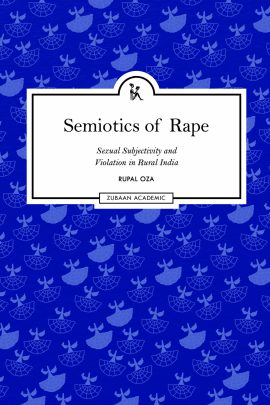
Semiotics of Rape
₹ 795In Semiotics of Rape, Rupal Oza follows the social life of rape in rural northwest India to reveal how rape is not only a violation of the body but a language through which a range of issues—including caste and gender hierarchies, control over land and labor, and the shape of justice—are contested. Rather than focus on the laws governing rape, Oza closely examines rape charges to show how the victims and survivors of rape reclaim their autonomy by refusing to see themselves as defined entirely by the act of violation. Oza also shows how rape cases become arenas where bureaucrats, village council members, caste communities, and the police debate women’s sexual subjectivities and how those varied understandings impact the status and reputations of individuals and groups. In this way, rape gains meaning beyond the level of the survivor and victim to create a social category. By tracing the shifting meanings of sexual violence and justice, Oza offers insights into the social significance of rape in India and beyond.
______________________________________________________________________________________RUPAL OZA is Professor of Women and Gender Studies at Hunter College, City University of New York, and author of The Making of Neoliberal India: Nationalism, Gender, and the Paradoxes of Globalization.
Continue Reading Semiotics of RapeIn stock
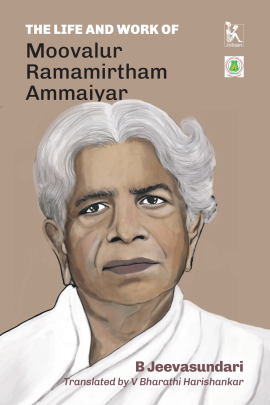
The Life and Work of Moovalur Ramamirtham Ammaiyar
Price range: ₹ 345 through ₹ 595
Moovalur Ramamirtham Ammaiyar spent almost her entire life fighting against the devadasi system in Tamil Nadu, a practice that dedicated young girls to temples, where they were meant to be available for the sexual needs of priests and landowners. Sold off by her parents, and brought up to dedicate herself as a dasi, she managed to escape this fate and make a life for herself. Her battle against the devadasi system was met with considerable resistance, not only by those with vested interests in keeping the devadasis inside temples, but often by the devadasis themselves. But Moovalur persisted, taking her cause, and its wider ramifications into the broader politics of the Congress party, and later the Self-Respect Movement. Despite this, in the annals of recent Tamil history, she was hardly known, until the publication, in 2006 of Moovalur Ramamirtham: Vazhvum Paniyum (translated here as The Life and Work of Moovalur Ramamirtham Ammaiyar). Put together through interviews with her surviving relatives and fragments garnered from a handwritten manuscript, this is the first book to document the ‘braveheart’ of Dravidian history, Moovalur Ramamirtham Ammaiyar.
Select format
This product has multiple variants. The options may be chosen on the product page B JEEVASUNDARI is a feminist researcher, writer and media person. She has contributed to various Tamil magazines including Pikika Children’s Magazine, Police News, Puthiya Paarvai, Araam Thinai, Kumudham Snegithi and Penne Nee. Moovalur Ramamirtham: Vazhvum Paniyum (The Life and Work of Moovalur Ramamirtham Ammaiyar) is the result of her independent research. She has also edited a book entitled, Thaneer – Santhaikalla Makkalukke. Her articles on women’s independence and violence against women have been compiled into volumes entitled, Penn enum Pagadaikkai and Kurallatra Bommaigal. Her abiding interest in movies has resulted in a set of serialised essays, ‘Raisgai Paarvai’ which have been published in the film critics magazine called Kaatchi Pizhai. The collection was later published as a book and received an award for the best feminist book. She has also received the Chinna Kuthoosi Award for her essays, and has translated many children’s books into Tamil.
V BHARATHI HARISHANKAR is vice chancellor of Avinashilingam Institute for Home Science and Higher Education for Women. Previously, she was the founding Head of the Department of Women’s Studies, University of Madras. Her research interests include postcolonial literatures, literary theory, translation studies and web-based pedagogies. She has taught courses, guided research, and has written over 120 publications including research articles, books, edited volumes and textbooks in all these areas. She has co-authored three books on teaching translation. Her notable translations include Shanmugasundaram’s Nagammal and Thamizachi Thangapandian’s Birthing Hut and Other Stories. Her interest in Moovalur Ramamirtham Ammaiyar stems from the project on devadasis that she has worked on for the National Commission for Women. Continue Reading The Life and Work of Moovalur Ramamirtham AmmaiyarOut of stock
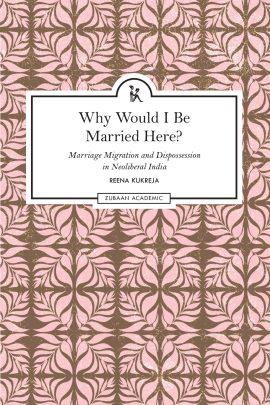
Why Would I Be Married Here: Marriage, Migration and Dispossession in Neoliberal India
₹ 895Why Would I Be Married Here? examines marriage migration undertaken by rural bachelors in North India, unable to marry locally, who travel across the breadth of India seeking brides who do not share the same caste, ethnicity, language, or customs as themselves. Combining rich ethnographic evidence with Dalit feminist and political economy frameworks, Reena Kukreja connects the macro-political violent process of neoliberalism to the micro-personal level of marriage and intimate gender relations to analyse the lived reality of this set of migrant brides in cross-region marriages among dominant-peasant caste Hindus and Meo Muslims in rural North India.
Why Would I Be Married Here? reveals how predatory capitalism links with patriarchy to dispossess many poor women from India's marginalized Dalit and Muslim communities of marriage choices in their local communities. It reveals how, within the context of the increasing spread of capitalist relations, these women's pragmatic cross-region migration for marriage needs to be reframed as an exercise of their agency that simultaneously exposes them to new forms of gender subordination and internal othering of caste discrimination and ethnocentrism in conjugal communities. Why Would I Be Married Here? offers powerful examples of how contemporary forces of neoliberalism reshape the structural oppressions compelling poor women from marginalized communities worldwide into making compromised choices about their bodies, their labour, and their lives.
REENA KUKREJA is assistant professor at Queen’s University.
Continue Reading Why Would I Be Married Here: Marriage, Migration and Dispossession in Neoliberal IndiaIn stock
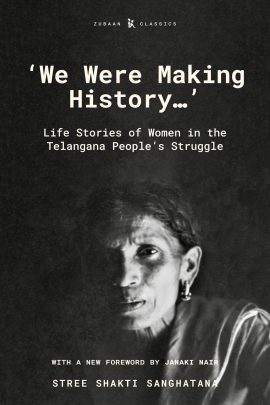
‘We Were Making History…’ (Zubaan Classics)
Price range: ₹ 630 through ₹ 895In the early 1980s, members of Stree Shakti Sanghatana, a Hyderabad women’s collective, set out to talk to women who had been part of the legendary Telangana People’s Struggle (1946-51), a rebellion which began in the erstwhile Hyderabad state and was put down by the newly inaugurated republic. The group interviewed more than 50 women, from well-known figures like Mallu Swarajyam, Chityala Ailamma and Jamalunnisa Baji to women across caste and class whose lives had been transformed by the struggle, like Kamalamma, Pramilatai, and Dudala Salamma. Sixteen of these interviews were published in Telugu as Manaku Teliyani Mana Charitra (1986) and translated into English as ‘We Were Making History…’: Life Stories of Women in the Telangana People’s Struggle (1989). This reprint presents that classic for a new generation of readers.
______________________________________________________________________________________
Stree Shakti Sanghatana was a Hyderabad women’s collective, active in the post-Emergency years up to the mid-eighties. It played a leading role in campaigns and research on a range of issues raised by the women’s movement, especially in the fields of law, education, historical studies, and health.
Continue Reading ‘We Were Making History…’ (Zubaan Classics)In stock

Unmoored
Price range: ₹ 280 through ₹ 395In Unmoored, Ramachandran Usha crafts an intimate exploration of migration and belonging. Three women—Ayesha, Indu, and Ameera—return to Chennai from the Gulf, each looking to reunite with the loved ones they left behind. Despite differences in religion, social status and age, they are also united in their quest for a true sense of home. Usha’s novella dwells on the seldom-told yet pervasive story of women who travel to the Middle East and beyond, driven by the need to secure their families’ futures.
The protagonists of the two short stories featured in this collection, ‘Khushka’, and ‘Success’, have much in common with the women of Unmoored, even as they grapple with crises of faith and finance.
______________________________________________________________________________________Ramachandran Usha has been writing in Tamil since 2003. She was awarded the second place in the KiVa Jagannathan Centenary Novel Award Competition for Karai Thedum Odangal (translated as Unmoored). She also won a short story competition held by Kalki and has been published widely in leading magazines and online journals.
Krupa Ge is a writer from Madras (Chennai). She is the author of a novel, What We Know About Her (2021) and a narrative non-fiction book, Rivers Remember (2019). Her reportage and cultural writings have appeared in Indian and international publications over the last 14 years.
Continue Reading UnmooredIn stock

The Fire of Defiance
Price range: ₹ 320 through ₹ 450
Even as the movement for Indian independence gathered momentum at the national level in the 1930s and ‘40s, a different kind of mobilization and struggle was unfolding in the Telangana region. Led by the Communist Party, the Telangana armed struggle swept through the Nizam’s dominions, targeting the exploitative practices of the doras, or landlords. Hundreds of men and women, from a wide spectrum of social locations, participated in the movement, and pictures of women wielding rifles have today become iconic.Among the many women in the movement was Mallu Swarajyam, who joined the armed squads of the movement and also became a cultural activist. Her extraordinary story, as told to three women, is captured here. In her words: “I also worked in the Kothagudem coal mines. Our informants were tribal women who went into the forest to gather mahuva flowers. On one occasion, we received information that the police were travelling in a bus along the route. I stormed onto the road, stopped the bus and punctured its tyres with my pistol.”______________________________________________________________________________________
Select format
This product has multiple variants. The options may be chosen on the product page Uma Chakravarti is a distinguished feminist historian who has taught at Miranda House College for Women, Delhi University. She writes on Buddhism, early Indian history, the nineteenth century, and on contemporary issues. Among her many publications are: Social Dimensions of Early Buddhism (1996), Rewriting History: The Life and Times of Pandita Ramabai (2013), Gendering Caste through a Feminist Lens (2018) and The Dying Lineage: The Crisis of Political Power in the Mahabharata (2024). She is closely involved with the women’s movement as well as the movement for democratic rights in India, and has been part of many fact-finding teams to investigate human rights violations, communal violence and state repression.
Vimala Morthala, a women’s rights activist, is noted for her poetry and short stories, and has published several anthologies of both. She edits the Mehfil page for Mana Telangana.
S. Katyayini is a noted Telugu writer and critic and has translated extensively from Telugu to English with a large body of work that includes anti-caste literature, novels and the stories of Bibhutibhushan Bandhopadhyay.
Purnima Tammireddy is a writer, translator and publisher, working in both Telugu and English. A techie by profession, she founded Elami Publications, an independent Telugu publishing house, and co-founded pustakam.net, a website for book reviews, in 2009. Her published works include a short story collection, Emotional Pregnancy (2022), Telugu translations of Manto’s Siya Hashiye (2022) and Amrita Pritam’s Pinjar (2023) and an English translation of the Telugu novel Pampateeram (2025).
Continue Reading The Fire of DefianceIn stock
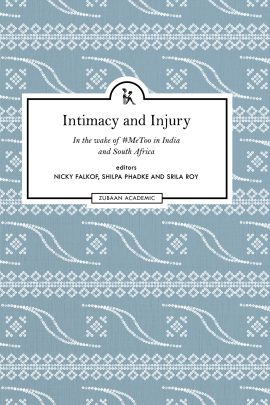
Intimacy and Injury: In the wake of #MeToo in India and South Africa
₹ 975
This book, a timely mapping of a shifting political field around gender-based violence in the global south, brings together academics and activists from South Africa and India who explore not only the disturbing prevalence of high levels of sexual violence but also the long histories of resistance to it. Using the lens of the #MeToo movement, the authors track the histories of feminist organising in both countries, while also revealing how newer strategies both extended and limited these struggles. In proposing comparative, interdisciplinary, ethnographically rich and analytically astute reflections on #MeToo, this book points to new and potentially transformative directions to scholarly debates and transnational feminist knowledge and solidarity in and across the global south.
NICKY FALKOF is an associate professor in the Media Studies department at the University of the Witswatersrand in Johannesburg. Her books include The End of Whiteness: Satanism and Family Murder in Late Apartheid South Africa (2016), Anxious Joburg: The Inner lives of a Global South City (2020) and Worrier State: Risk, Anxiety and Moral Panic in South Africa (2022). Her research is concerned with race, anxiety and the media in the urban global south.SHILPA PHADKE is a professor at the School of Media and Cultural Studies, Tata Institute of Social Sciences, Mumbai. She is co-author of the critically acclaimed book, Why Loiter: Women and Risk on Mumbai Streets (2011), and co-director of the film, Under the Open Sky (2016). She has published both academically and in mainstream media on gender and public space, ethnographies of feminism, feminist pedagogy, risk and the city, middle-class sexualities, and the new spaces of consumption, and feminist parenting. She is currently editing an anthology on friendship and its possibilities in South Asia.SRILA ROY is professor of Sociology and Head of Development Studies at the University of Witswatersrand, South Africa. She is author of Remembering Revolution: Gender, Violence and Subjectivity in India’s Naxalbari Movement (2012), editor of New South Asian Feminisms (2012), and co-editor of New Subaltern Politics: Reconceptualising Hegemony and Resistance in Contemporary India (2015). Her book on queer feminist politics in liberalized India is forthcoming. At Wits, she leads the Governing Intimacies project, which promotes new scholarship on gender and sexuality in South Asia and India, with support from the Andrew W. Mellon Foundation. Continue Reading Intimacy and Injury: In the wake of #MeToo in India and South Africa
Add to cart
NICKY FALKOF is an associate professor in the Media Studies department at the University of the Witswatersrand in Johannesburg. Her books include The End of Whiteness: Satanism and Family Murder in Late Apartheid South Africa (2016), Anxious Joburg: The Inner lives of a Global South City (2020) and Worrier State: Risk, Anxiety and Moral Panic in South Africa (2022). Her research is concerned with race, anxiety and the media in the urban global south.SHILPA PHADKE is a professor at the School of Media and Cultural Studies, Tata Institute of Social Sciences, Mumbai. She is co-author of the critically acclaimed book, Why Loiter: Women and Risk on Mumbai Streets (2011), and co-director of the film, Under the Open Sky (2016). She has published both academically and in mainstream media on gender and public space, ethnographies of feminism, feminist pedagogy, risk and the city, middle-class sexualities, and the new spaces of consumption, and feminist parenting. She is currently editing an anthology on friendship and its possibilities in South Asia.SRILA ROY is professor of Sociology and Head of Development Studies at the University of Witswatersrand, South Africa. She is author of Remembering Revolution: Gender, Violence and Subjectivity in India’s Naxalbari Movement (2012), editor of New South Asian Feminisms (2012), and co-editor of New Subaltern Politics: Reconceptualising Hegemony and Resistance in Contemporary India (2015). Her book on queer feminist politics in liberalized India is forthcoming. At Wits, she leads the Governing Intimacies project, which promotes new scholarship on gender and sexuality in South Asia and India, with support from the Andrew W. Mellon Foundation. Continue Reading Intimacy and Injury: In the wake of #MeToo in India and South Africa